



Ask any parent what they wish they had more of, and the answer is usually time. Dinner is rushed, phones are everywhere, and everyone eats at a different hour. Then a child refuses vegetables, a parent’s sugar level creeps up, and a grandparent sits alone in front of the TV.
So, what are family habits? They are the small things your household does again and again, without much thought: how you eat, move, sleep, and talk. This guide explains why healthy family habits matter and gives you 12 to start at home this week, using ordinary food and a normal budget.
- Key takeaways
- What Are Family Habits?
- Why Healthy Family Habits Matter
- 12 Healthy Family Habits to Start at Home
- 1. Eat at least one meal together
- 2. Cook together
- 3. Fill half the plate with vegetables
- 4. Keep fruit visible and biscuits out of sight
- 5. Make water the family drink
- 6. Move together every day
- 7. Set screen rules that everyone follows
- 8. Fix a sleep routine
- 9. Talk about feelings every day
- 10. Build basic hygiene habits
- 11. Plan the week together
- 12. Treat sweets as treats, not rewards
- How to Start Without Overwhelming Everyone
- A Sample Week of Family Habits
- Mistakes That Stop Healthy Family Habits From Sticking
- Can healthy family habits help children stay at a healthy weight?
Key takeaways
- Family habits are everyday routines your household repeats, whether healthy or not.
- Children copy what adults do, so shared habits work better than rules for kids alone.
- Start with two habits, such as dinner together and an evening walk, and add one every two weeks.
- Use a simple chart to tick habits daily and keep everyone on track.
What Are Family Habits?
Family habits are routines that run on repeat in your home. Evening chai together, shoes left at the door, TV on during dinner, ordering in every Friday: all of these count. Some are good for your health and some are not, but nobody planned them. They just formed.
Healthy family habits are the ones that support everyone’s physical, mental, and emotional health, and they work best when the whole household shares them. Children copy what they see. If a parent drinks water, walks after dinner, and keeps the phone away at the table, the child is far more likely to do the same than if they only hear a lecture.
Why Healthy Family Habits Matter
- Children learn at home. Eating and activity patterns picked up in childhood often last into adult life.
- Adults support each other. It is easier to skip a sweet drink when nobody else is having one.
- Home food is usually better. It tends to be lower in sugar, salt, and oil than takeaway, and it costs less.
- Shared routines build closeness. That helps mental health too, for kids and adults alike.
None of this needs a gym membership or special food. It needs repetition.
12 Healthy Family Habits to Start at Home
1. Eat at least one meal together
Pick one meal that works for everyone, usually dinner or Sunday lunch. Sit at the table, serve small portions, and talk. Research links regular family meals with better diet quality, and children get a fixed time to share their day. It does not have to be every night. Four or five days a week is a good start.
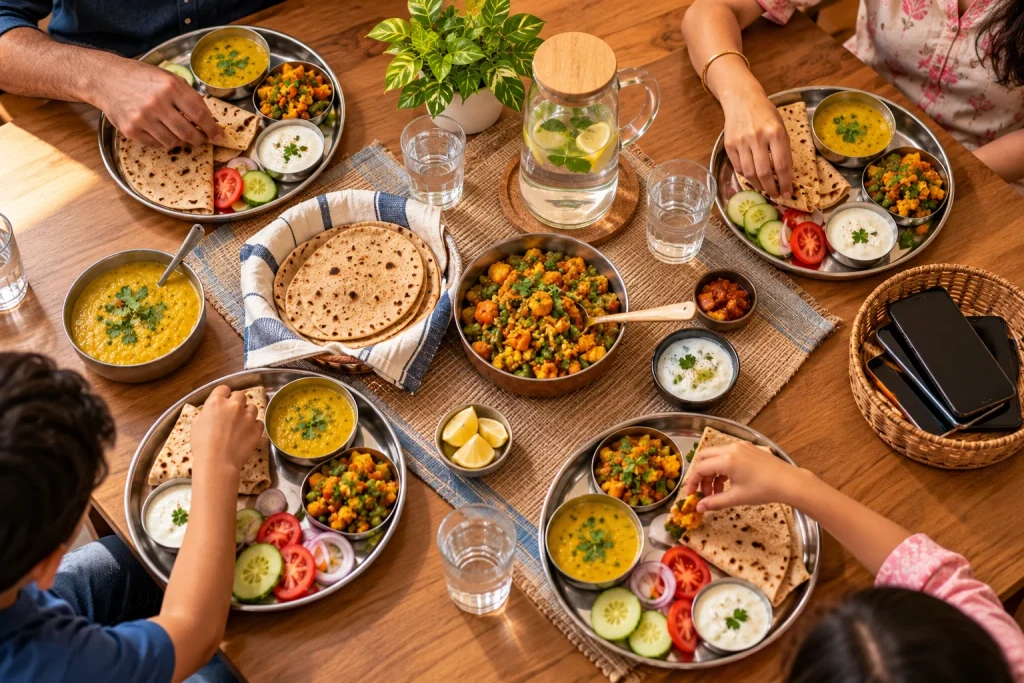
2. Cook together
Give each person a job. A six-year-old can wash tomatoes, a ten-year-old can mix a salad, and a teenager can make a simple dal or sandwich. Children who help cook are usually more willing to try what they made. Grandparents can pass on home recipes, which are almost always healthier than anything from a packet. Cooking together is one of the easiest healthy family habits to start, because it needs no extra money, only a shared kitchen.
3. Fill half the plate with vegetables
Serve the sabzi and salad first, then add roti or rice. If a child pushes vegetables away, keep offering without pressure. New tastes can take many tries. Our guide to tips to eat healthy has 15 simple food habits that suit the whole family.
4. Keep fruit visible and biscuits out of sight
Put a fruit bowl on the dining table and the packaged snacks on a high shelf. People eat what they can see. Buy fewer chips, namkeen, and biscuits, because if they are not at home, nobody eats them at 11 pm. Roasted chana, makhana, and sliced fruit make easy swaps.
5. Make water the family drink
Give each person a bottle and refill together. Cut back on cold drinks, packaged juice, and sweet milk drinks. Fizzy drinks can be an occasional treat, not part of every meal. If your family needs a reason, why too much sugar is bad for your health explains it in plain language.
6. Move together every day
The World Health Organization suggests children and teenagers get an average of 60 minutes of moderate to vigorous activity a day, and adults at least 150 minutes a week. Do not think of it as exercise. An evening walk, cycling on Sunday, badminton in the lane, or dancing in the living room all count. On busy days, this 10-minute home workout for beginners can be done by older kids and adults together.

7. Set screen rules that everyone follows
Rules only work when parents follow them too. Keep phones and TV off during meals, and keep devices out of the bedroom at night. Choose one screen-free hour in the evening for board games, stories, or just talking. Screen rules are among the healthy family habits that fail fastest when parents make exceptions for themselves.
8. Fix a sleep routine
School-age children need roughly 9 to 12 hours of sleep, teenagers about 8 to 10, and adults seven or more. Keep bedtime and wake-up time steady, as far as possible even on weekends. Dim the lights and switch off screens 30 minutes before bed so that everyone falls asleep faster.
9. Talk about feelings every day
Health is not only food and exercise. Ask one question at dinner: “What was the best part of your day, and what was hard?” Listen without fixing or scolding. Children who feel heard tend to share problems earlier, and adults feel less alone too. Talking is one of the most underrated healthy family habits, and it costs nothing.
10. Build basic hygiene habits
Washing hands before meals and after using the toilet, brushing teeth twice a day, and keeping nails trimmed sound basic, but they prevent many common illnesses. Make them a routine: brush together morning and night, and wash hands as soon as everyone gets home. These are healthy family habits that protect the youngest and the oldest members the most.
11. Plan the week together
On Sunday, spend ten minutes deciding what to cook, and let each person choose one dish. Shop together and read labels with older kids. Planning cuts down on last-minute ordering and wasted food, and it makes healthy family habits easier to keep.
12. Treat sweets as treats, not rewards
Avoid using chocolate or sweets as a prize for good marks or good behaviour, and never as a way to stop a child from crying. It teaches children to link food with emotions. Have mithai at festivals and ice cream on weekends, and enjoy them slowly. A healthy household does not ban sweets. It keeps them occasional.
How to Start Without Overwhelming Everyone
Trying all 12 healthy family habits at once will not work. Follow these steps instead:
- Hold a short family meeting and ask each person to choose one habit.
- Start with two habits for the whole house. Meals together and an evening walk are easy first picks.
- Put your habits on a chart and tick them every day. Our free healthy habits worksheet has a 30-day grid you can print and stick on the fridge.
- Add one new habit every two weeks.
- Celebrate small wins with something that is not food, like a picnic, a movie night, or an extra bedtime story.
If someone asked you to explain how you can take control of your health as a family, this is the answer: choose small things, repeat them, and do them together.
A Sample Week of Family Habits
Here is how healthy family habits can fit into an ordinary week. Change the days to match your schedule.
| Day | Habit |
|---|---|
| Monday | Dinner together, phones away |
| Tuesday | 20-minute evening walk |
| Wednesday | Cook one dish together |
| Thursday | Screen-free hour with a board game |
| Friday | Plan Sunday’s menu together |
| Saturday | Family sports or cycling |
| Sunday | Cook-and-eat lunch together |
Mistakes That Stop Healthy Family Habits From Sticking
- Making rules only for the kids. Children notice when adults do not follow them.
- Changing everything at once. Two habits is enough to begin with.
- Using food as a reward or punishment. It creates an unhealthy link with eating.
- Nagging. Invite people to join in instead of ordering them.
- Expecting perfection. Festivals, exams, and travel will disturb your routine. Restart the next day.
Frequently Asked Questions
What are family habits?
Family habits are routines that a household repeats regularly, such as how and when you eat, move, sleep, and talk. They can be healthy or unhealthy, and they shape everyone’s wellbeing.
What are some examples of healthy family habits?
Eating dinner together, cooking at home, evening walks, keeping fruit within reach, drinking water instead of sugary drinks, and a fixed bedtime are all simple examples.
How do I get my whole family to eat healthy?
Change the home environment first. Stock fruit and vegetables, keep packaged snacks limited, and cook together. People copy what is in front of them, so start with your own plate.
How do I get a picky child to eat vegetables?
Offer vegetables repeatedly without pressure, let the child help prepare them, and serve a small portion next to a food they already like. It can take 10 or more tries before a child accepts a new taste.
How long does it take to form a family habit?
Research suggests an average of around two months for a habit to feel automatic, though it varies. Families often take longer, so focus on one or two habits at a time.
What if one family member refuses to join in?
Do not force it. Keep the habit going yourself, invite them without pressure, and let them see the benefits. Change often follows when it feels normal at home.
Can healthy family habits help children stay at a healthy weight?
They can help. Regular meals, more movement, less sugary food, and enough sleep all support healthy growth. Avoid putting children on diets, and speak to a paediatrician if you are worried about weight.
How much screen time is fine for children?
It depends on age. A paediatrician can guide you, but a good rule for every family is no screens during meals and none in the hour before bed.
You do not need a perfect routine to start. Pick two of these healthy family habits, try them for two weeks, and add more as they settle. For more practical guides on food, fitness, and everyday wellness, browse Try For Health.
If anyone in your family has a medical condition, allergy, or special dietary need, check with a doctor or dietitian before changing meals or exercise.