


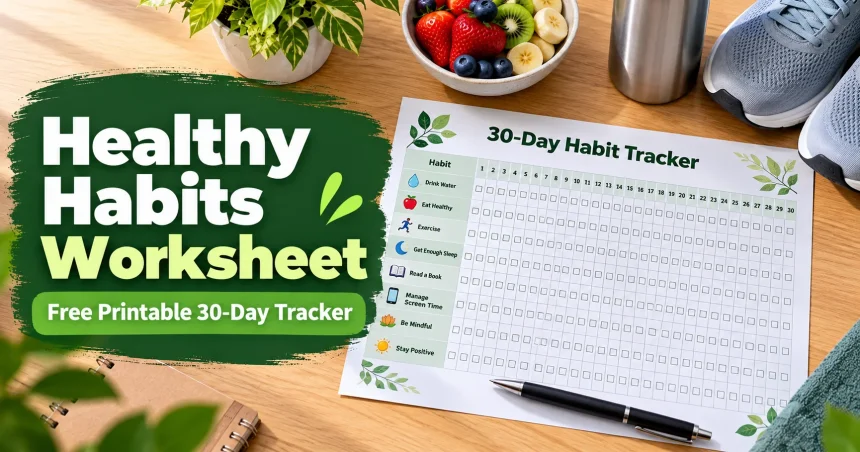
Everyone starts a new routine with energy. Drink more water, walk daily, sleep early, eat less sugar. By day four, one missed evening turns into a missed week, and the plan quietly disappears. Sound familiar?
- What Is a Healthy Habits Worksheet?
- Why a Worksheet for Healthy Habits Actually Works
- What Is Inside the 30-Day Tracker
- Who Can Use This Worksheet
- How to Use This Worksheet for Healthy Habits
- Step 1: Pick only three to five habits
- Step 2: Make each habit small and clear
- Step 3: Attach it to something you already do
- Step 4: Tick the box the same day
- Step 5: Do the weekly check-in
- Step 6: Plan for slips
- What to Put on Your Worksheet for Healthy Habits
- A Simple Plan for the Four Weeks
- Mistakes That Make a Worksheet for Healthy Habits Fail
- What to Do After 30 Days
- Frequently Asked Questions
- Where can I get a free healthy habits worksheet?
- How many habits should I put on a worksheet for healthy habits?
- Is 30 days enough to build a habit?
- What if I miss a day?
- What are good healthy habits for beginners?
- Is a worksheet for healthy habits better on paper or on an app?
- Can the healthy habits worksheets be used by children or families?
- How long should I use a worksheet for healthy habits?
- Recent posts (add at the end of the blog)
The fix is rarely more motivation. It is a simple system you can see. A healthy habits worksheet puts your goals on one page, lets you tick off each day, and shows you where things slip. This guide explains how to use the free 30-day worksheet for healthy habits below, what to put on it, and how to keep going after the first week.
What Is a Healthy Habits Worksheet?
A healthy habits worksheet is a printable page where you list the habits you want to build and mark them off every day. Think of it as a paper scoreboard for your daily routine. Many people also call it a habit tracker or a healthy habits checklist.
Search for healthy habits worksheets and you will find hundreds of designs, from cute to cluttered. The best ones share three things: few habits, a clear daily tick box, and space to write what went wrong. That is exactly how this tracker is set up.
Why a Worksheet for Healthy Habits Actually Works
If someone asked you to explain how you can take control of your health, the honest answer would be: by changing small things you do every day. A worksheet for healthy habits makes those small things visible.
Here is why that helps:
- You see your pattern. Memory is unreliable. A page with 12 ticks out of 30 tells you the truth without any guilt.
- It makes the next step obvious. You do not have to decide what to do each morning. The list decides.
- Ticking feels good. A small win every day keeps you going when motivation drops.
- It sets a realistic timeline. One well-known study from University College London found that new habits took about two months on average to feel automatic, and the range was wide, from under three weeks to many months. Thirty days is a strong start, not a finish line.
What Is Inside the 30-Day Tracker
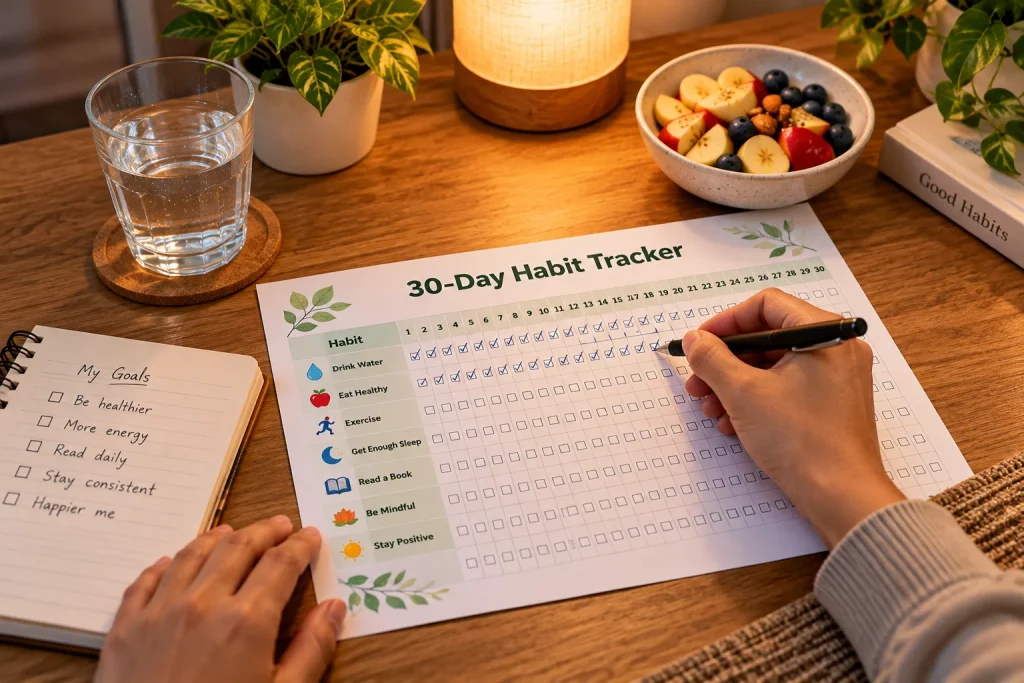
This worksheet for healthy habits has four parts, all on a single A4 page:
- My goal box. One line on why you want this, such as “I want more energy in the evening.”
- The habit grid. Up to five habits in rows, with 30 small boxes each, one for every day.
- A weekly check-in. Four short prompts at the end of each week: What went well? What got in the way? What will I change? How do I feel?
- A notes strip. A space for slips, sick days, or travel, so one bad day does not feel like a failure.
Here is how one row looks once you start:
| Habit | Mon | Tue | Wed | Thu | Fri | Sat | Sun |
|---|---|---|---|---|---|---|---|
| Drink 8 glasses of water | ✓ | ✓ | ✓ | ✓ | ✗ | ✓ | ✓ |
| 10-minute walk after dinner | ✓ | ✗ | ✓ | ✓ | ✓ | ✗ | ✓ |
| Phone off by 10:30 pm | ✓ | ✓ | ✗ | ✓ | ✓ | ✓ | ✗ |
Download the free printable 30-day tracker (PDF)
Print it, stick it on the fridge or next to your bed, and keep a pen close by.
Who Can Use This Worksheet
Almost anyone. Students can use it to fix a messy sleep schedule. Office workers can use it to add movement to a desk-heavy day. Parents can pick two habits for the whole family, such as dinner at the table and a walk on weekends. Older adults can use larger print and fewer rows. A worksheet for healthy habits stays flexible because you decide the habits. If you are managing a health condition, ask your doctor which habits suit you before you start.
How to Use This Worksheet for Healthy Habits
Step 1: Pick only three to five habits
The most common mistake is writing ten habits on day one. Start with three. If they feel easy by week two, add a fourth. Choose habits that match your real life, not your ideal life.
Step 2: Make each habit small and clear
“Eat healthy” is too vague to tick. “Add one vegetable to lunch” is not. Write habits so you can answer yes or no at the end of the day. A good test is this: can you finish the habit in under ten minutes?
Step 3: Attach it to something you already do
Link the new habit to an existing one. “After brushing my teeth at night, I fill my water bottle for tomorrow.” “After my evening chai, I walk for ten minutes.” This kind of if-then plan is easier to remember, and research on planning suggests people follow through more often when they decide when and where in advance.
Step 4: Tick the box the same day
Mark your worksheet for healthy habits before bed, every night. Do not fill it in on Sunday from memory. If you missed a habit, put a cross and move on.
Step 5: Do the weekly check-in
On the seventh day, spend five minutes on the check-in section of your worksheet for healthy habits. If a habit failed three or more times, it is probably too big or at the wrong time. Shrink it or move it.
Step 6: Plan for slips
You will miss days. Use a simple rule: never miss twice in a row. One missed day is an accident. Two starts a new habit you did not want.
What to Put on Your Worksheet for Healthy Habits
Not sure where to begin? Choose from these ideas, one or two per area.
Food
- Add a vegetable or fruit to two meals a day.
- Have a protein source like dal, eggs, or curd at every meal.
- Skip sugary drinks, or cut sugar in your tea by half.
For a longer list, our guide to tips to eat healthy explains 15 habits for a good diet, with Indian meal ideas. And if sweets are your weak spot, it helps to know why too much sugar is bad for your health.
Movement
- Walk for ten minutes after a meal.
- Do a short workout three times a week. This 10-minute home workout for beginners needs no equipment.
- Stand up and stretch every hour if you sit at a desk. If your back complains by evening, these home remedies for back pain relief are worth a look.
The World Health Organization suggests adults aim for at least 150 minutes of moderate activity a week. That is just over 20 minutes a day, which a walk after dinner can cover.
Sleep
- Keep the phone away from the bed 30 minutes before sleep.
- Wake up at roughly the same time every day.
- Aim for seven hours.
Water and body care
- Drink a glass of water on waking.
- Follow a basic night routine for your skin. If yours is oily, this night care routine for oily skin gives a simple order of steps.
Mind
- Five minutes of quiet breathing.
- One line in a notebook about your day.
- No phone during meals.
A Simple Plan for the Four Weeks
You do not need to start everything on day one. This slow build works well with a worksheet for healthy habits, because each new habit gets a full week of attention.
| Week | Focus | Example |
|---|---|---|
| Week 1 | Start with one easy habit | Fill your water bottle every night |
| Week 2 | Add a second habit | Walk for ten minutes after dinner |
| Week 3 | Add a third habit | Phone off 30 minutes before sleep |
| Week 4 | Hold all three, adjust what is hard | Review and tweak |
Mistakes That Make a Worksheet for Healthy Habits Fail
- Too many habits. Five is the upper limit. Two or three is better.
- Perfectionism. One cross does not ruin your month. Look at the whole grid, not one box.
- Vague goals. If you cannot tick it with a clear yes or no, rewrite it.
- Copying someone else’s list. A runner’s habits will not fit a night-shift nurse. Build your own.
- Forgetting the reason. Keep your goal line visible so you remember why you are doing this.
What to Do After 30 Days
Look at your grid. Any habit with 25 or more ticks is on its way to becoming automatic. Keep tracking it lightly, perhaps just weekly. Any habit with fewer than 15 ticks needs a redesign: make it smaller, move it to another time, or swap it for something easier.
Then start a fresh page. Many people repeat the worksheet for healthy habits a second month with one new habit added. Once a habit stops needing a tick, you can drop it from the sheet, and that is the real goal.
Frequently Asked Questions
Where can I get a free healthy habits worksheet?
You can download the free printable 30-day tracker from this page. Print it on A4 paper, or save it on a tablet and use a stylus.
How many habits should I put on a worksheet for healthy habits?
Start with three, and five at the very most. A short list is easier to finish, and finishing builds confidence.
Is 30 days enough to build a habit?
For most people, 30 days builds a strong routine but not always a fully automatic one. Research suggests an average of around two months, so treat 30 days as a solid beginning and continue afterwards.
What if I miss a day?
Nothing is lost. Mark a cross, note why, and carry on the next day. Try not to miss two days in a row.
What are good healthy habits for beginners?
Drinking water, a short daily walk, an earlier bedtime, and one extra vegetable a day are easy to start with and show results quickly.
Is a worksheet for healthy habits better on paper or on an app?
Both work. Paper is easier to notice on your wall or desk, and many people like the feeling of ticking a box. Choose whichever you will actually open every day.
Can the healthy habits worksheets be used by children or families?
Yes. Use one shared sheet with simple habits, like drinking water, sleeping on time, or playing outside, and let everyone tick their own row.
How long should I use a worksheet for healthy habits?
Use it until the habits feel automatic, which may be one to three months. After that, check in weekly or monthly.
You do not need to overhaul your life to feel healthier. Pick three small habits, print the sheet, and tick the first box today. For more practical guides on food, fitness, and daily wellness, browse Try For Health.
If you have a medical condition, are pregnant, or take regular medicines, talk to your doctor before making big changes to your diet or exercise.