

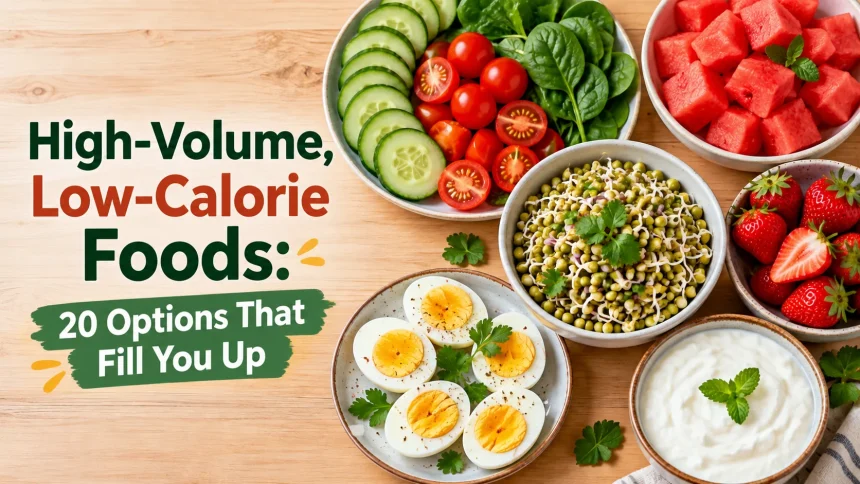
You finish dinner, and an hour later you are back in the kitchen looking for something to eat. Most of us have been there. The problem is usually not willpower. The meal simply had plenty of calories but not enough bulk to make your stomach feel full.
That is where high volume low calorie food helps. These are foods that take up a lot of space on your plate and in your stomach but add very few calories. You eat a big portion, feel satisfied, and still stay within your calorie goal.
In this guide, we will look at what makes a food high volume, which ones work best, and how to turn them into filling meals you will actually enjoy.
- What high volume low calorie food actually means
- Why these foods keep you full
- 20 high volume low calorie food ideas
- What is the most filling food with the least calories?
- How to build filling meals
- How to eat less at the table
- Using these foods for weight loss
- Common mistakes to avoid
- The bottom line
- FAQs: High-Volume Low-Calorie Foods
- 1. What are high-volume low-calorie foods?
- 2. Which food is the most filling with the fewest calories?
- 3. Can high-volume low-calorie foods help with weight loss?
- 4. What are some filling meals that are low in calories?
- 5. Are nuts, ghee, and dry fruits bad for weight loss?
- 6. Can I live only on low-calorie foods to lose weight faster?
- 7. How do you eat less without feeling hungry?
- 8. Is a boiled potato really a low-calorie food?
- 9. Is fruit juice as filling as whole fruit?
- 10. Should people with diabetes or kidney problems follow this way of eating?
What high volume low calorie food actually means
Every food packs a certain number of calories into each gram. Nutrition researchers call this energy density. A low calorie dense food, like cucumber, gives you very few calories per gram. A dense food, like a handful of nuts or a piece of mithai, gives you a lot of calories in a tiny bite.
Barbara Rolls, a nutrition researcher at Penn State, has studied this idea for years, and her work is behind the “Volumetrics” way of eating. The basic finding is simple. People tend to eat roughly the same weight of food each day. If that food is light on calories, total intake drops without much effort.
So a high volume low calorie food is usually something full of water and fiber: vegetables, fruits, clear soups, and some grains and legumes once they are cooked. These are also the foods with the least calories per bite.
Why these foods keep you full
Three things make a food filling.
Water. Water adds weight and volume without adding calories. Watermelon is over 90 percent water, so a big bowl fills your stomach fast.
Fiber. Fiber slows digestion and stretches the stomach a little, which tells your brain you have had enough. Vegetables, fruits, oats, and dal all bring fiber.
Protein. Of the three main nutrients, protein keeps hunger away the longest. Eggs, curd, and lentils are good examples.
If you have ever asked yourself how do you eat less without feeling deprived, this is the honest answer. You do not fight hunger. You choose foods that handle it for you.
20 high volume low calorie food ideas
Calories are approximate and given per 100 grams unless mentioned otherwise.
Vegetables
- Cucumber (15 calories): Crunchy and watery. Sprinkle some chaat masala and lemon juice and it feels like a snack.
- Tomato (18): Good raw in salads, and it adds body to almost any curry.
- Lauki or bottle gourd (about 15): Cooks soft and absorbs spices well. Makes a light sabzi, raita, or soup.
- Spinach (23): Shrinks a lot when cooked, so use a big bunch. Add it to dal, eggs, or parathas.
- Cauliflower (25): Roast it, make a dry sabzi, or grate it as a rice substitute.
- Cabbage (25): Raw in slaws or stir-fried with mustard seeds and a pinch of turmeric.
- Mushrooms (22): The meaty texture makes a curry feel richer than it really is.
Fruits
- Watermelon (30): Sweet, cold, and mostly water. A good replacement for dessert.
- Strawberries (32): They handle sweet cravings and give you some fiber too.
- Oranges (47): Eat the whole fruit rather than the juice, because you need the fiber.
- Papaya (43): Soft, easy to digest, and filling in a bowl with a squeeze of lime.
- Apples (52): Keep the peel on. It holds a good share of the fiber.
Protein, grains, and legumes
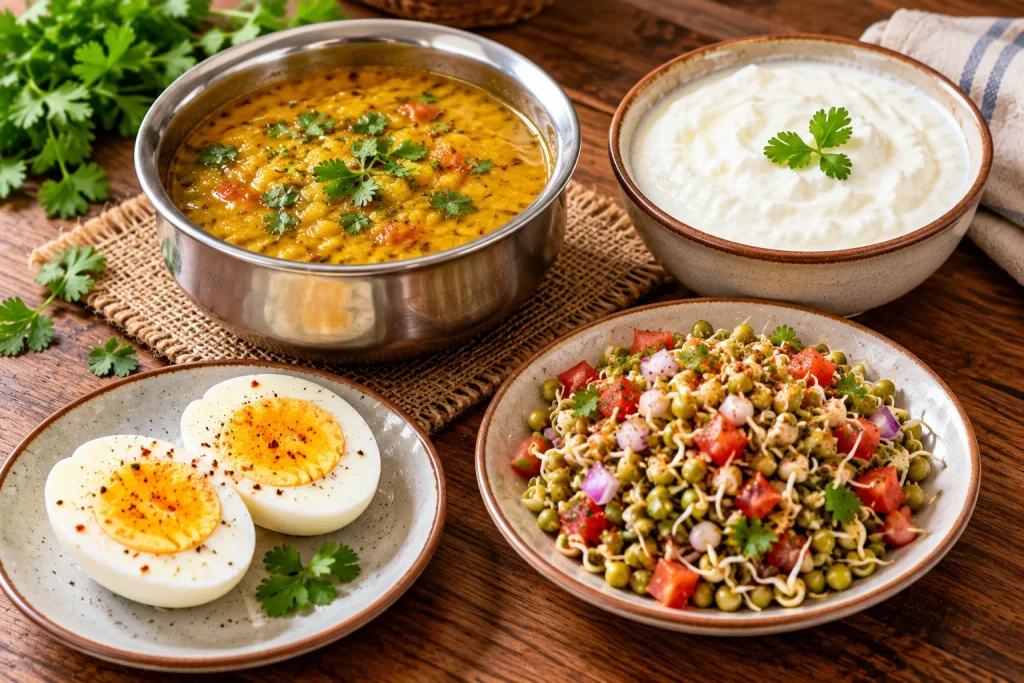
- Plain Greek yogurt or thick curd (about 60): Protein keeps you full. Add fruit instead of sugar.
- Eggs (about 72 calories per large egg): High in protein for the calories. Boiled eggs are an easy snack.
- Moong sprouts (30): Toss with onion, tomato, and lemon for a quick chaat.
- Cooked dal (about 115): Fiber and protein together. This is one of the best everyday foods in an Indian kitchen.
- Cooked oats (about 70): Oats absorb a lot of water while cooking, so a bowl looks big and sits well in the stomach.
- Air-popped popcorn (about 31 per cup): A large bowl for very few calories. Skip the butter and go easy on the salt.
- Clear vegetable soup (roughly 50 to 100 per bowl): Depends on what goes in, but it is hard to overeat.
- Boiled potato (87): Yes, potato. More on this below.
Pick any high volume low calorie food from this list and pair it with a source of protein, and you have the start of a proper meal.
What is the most filling food with the least calories?
There is no single winner, but there is a useful clue. In a well-known 1995 study from the University of Sydney, researchers gave people equal-calorie portions of 38 different foods and tracked how full they felt afterward. Boiled potatoes scored the highest, well above white bread. Fish, oatmeal, oranges, and apples also did well. Croissants, cake, and doughnuts were near the bottom.
The pattern is easy to see. Whole, simple, water-rich, or fiber-rich foods fill you better than processed ones. That is why most low calorie high satiety foods come from the kitchen and not from a packet, and why a simple, whole high volume low calorie food usually beats anything that comes in a wrapper.
How to build filling meals
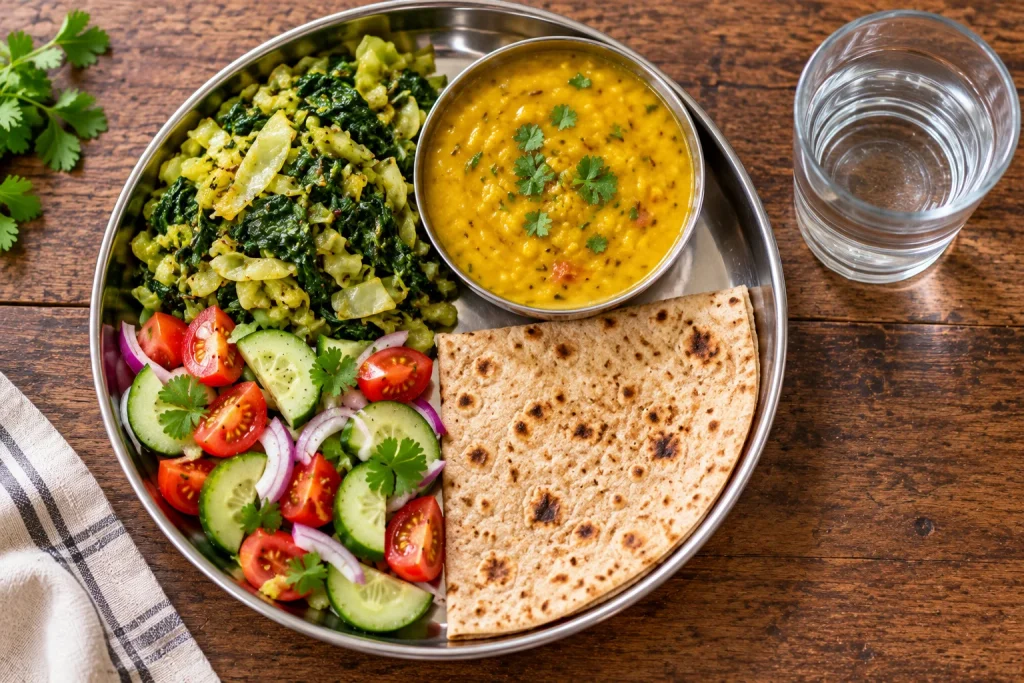
You do not have to eat only low-calorie foods. The idea is to build filling meals where the bulky foods take up most of the plate. A simple rule is to fill half the plate with vegetables, a quarter with protein, and a quarter with a carb such as roti, rice, or millet.
Here are a few ideas. Each one is built around at least one high volume low calorie food.
- Breakfast: Oats cooked in water or milk with sliced apple and a spoon of curd. Or a two-egg vegetable omelette with tomato and cucumber on the side.
- Lunch: One roti, a bowl of dal, a large serving of lauki or cabbage sabzi, and a plate of salad.
- Snack: A bowl of watermelon, sprouts chaat, or a cup of plain popcorn.
- Dinner: A clear vegetable soup first, then mushroom and spinach curry with one roti.
Starting a meal with soup or salad is worth trying. Some studies, including Rolls’ own work, have found that people who begin with a low-calorie soup tend to eat less during the rest of the meal.
How to eat less at the table
The food matters, but so do a few small habits.
- Drink a glass of water before you sit down.
- Use a smaller plate and fill it with vegetables first.
- Eat slowly. Your brain needs around 20 minutes to register fullness.
- After your first serving, wait ten minutes before going back for more. Most of the time the urge passes.
Using these foods for weight loss
A high volume low calorie food works best as the base of your meals, not as the whole plan. If you are looking at low calorie high volume foods for weight loss, keep these points in mind:
- Watch the cooking oil. A sabzi made with three spoons of oil is no longer light. One teaspoon of oil adds about 40 calories.
- Skip liquid calories. Sugary drinks and packaged juices give you calories with almost no fullness. To see what they do over time, read why too much sugar is bad for your health.
- Read menus carefully. Food that sounds light can surprise you. Sushi rolls are a good example, and this breakdown of how many calories are in sushi rolls shows how quickly the numbers add up.
- Keep dense foods small. Nuts, dry fruits, ghee, and peanut butter are healthy, but a little goes a long way.
Common mistakes to avoid
Eating only salad. You will feel hungry in an hour and end up eating something heavy at night. Add protein and some carbs so the meal holds.
Relying on one food. Even the best high volume low calorie food cannot give you every nutrient. Rotate vegetables, fruits, and protein through the week.
Cutting calories too low. Very low intake leads to tiredness and stronger cravings. Small, steady changes work better than crash diets.
Choosing juice over fruit. Juice removes most of the fiber, so it fills you far less than the whole fruit.
The bottom line
Feeling full on fewer calories is mostly about choosing the right foods and building the plate the right way. Choosing a high volume low calorie food at each meal is one of the simplest ways to do that. Fill up on vegetables, fruits, dal, curd, and eggs, and keep the heavier items in smaller portions.
For more practical food and health guides, you can browse Try For Health. And if you have diabetes, kidney problems, or any other medical condition, talk to a doctor or registered dietitian before you change your diet.
FAQs: High-Volume Low-Calorie Foods
1. What are high-volume low-calorie foods?
These are foods that take up a lot of space in your stomach but have very few calories. Most are full of water and fiber, such as cucumber, watermelon, spinach, cauliflower, mushrooms, and cooked oats. You can eat a large portion and still stay within your calorie limit.
2. Which food is the most filling with the fewest calories?
There is no single best food, but boiled potatoes, oats, eggs, dal, curd, apples, and oranges score very well for fullness. Whole foods that contain water, fiber, or protein keep you full longer than processed snacks.
3. Can high-volume low-calorie foods help with weight loss?
Yes, they can help. Because these foods fill you up for fewer calories, it becomes easier to eat less without feeling hungry. They work best as the base of your meals, along with enough protein, and not as the only thing you eat.
4. What are some filling meals that are low in calories?
Good examples are dal with roti and a large vegetable sabzi, a vegetable omelette with salad, oats with fruit and curd, moong sprouts chaat, and clear vegetable soup with a small portion of rice or roti.
5. Are nuts, ghee, and dry fruits bad for weight loss?
No, they are healthy in small amounts. They are just calorie-dense, meaning a small portion carries a lot of calories. A handful of nuts or a teaspoon of ghee is fine, but larger portions can add up quickly.
6. Can I live only on low-calorie foods to lose weight faster?
This is not a good idea. Eating too little can cause tiredness, weak muscles, and strong cravings that lead to overeating later. Steady, moderate changes work better and are easier to keep up.
7. How do you eat less without feeling hungry?
Start your meal with a salad or soup, fill half your plate with vegetables, add protein to each meal, and eat slowly. It takes about 20 minutes for your brain to register that you are full, so wait a few minutes before going for a second serving.
8. Is a boiled potato really a low-calorie food?
A boiled potato has about 87 calories per 100 grams, which is low for how filling it is. The calories go up quickly when you fry it or add lots of butter, so boiling, baking, or air-frying is the better choice.
9. Is fruit juice as filling as whole fruit?
No. Juice removes most of the fiber, so it fills you up much less and can add more sugar than you realize. Eating a whole orange or apple keeps you full for longer than a glass of juice.
10. Should people with diabetes or kidney problems follow this way of eating?
Many of these foods are healthy for most people, but if you have diabetes, kidney disease, or any other medical condition, talk to your doctor or a registered dietitian first. Some foods, like certain fruits and potatoes, may need portion control in your case.