

What’s the Difference Between Presbyopia and Hypermetropia?
Imagine trying to read a menu in low light and holding it far away just to see the words clearly. If you are in your 40s or older, this may feel familiar. Two common eye conditions are often responsible for this problem: presbyopia and hypermetropia.
- What’s the Difference Between Presbyopia and Hypermetropia?
- What is Presbyopia?
- What is Hypermetropia?
- Symptoms and Causes of Presbyopia
- Symptoms and Causes of Hypermetropia
- Difference Between Presbyopia and Hypermetropia (Comparison Table)
- Presbyopia vs Hypermetropia – Treatment in India
- Summary
- Frequently Asked Questions
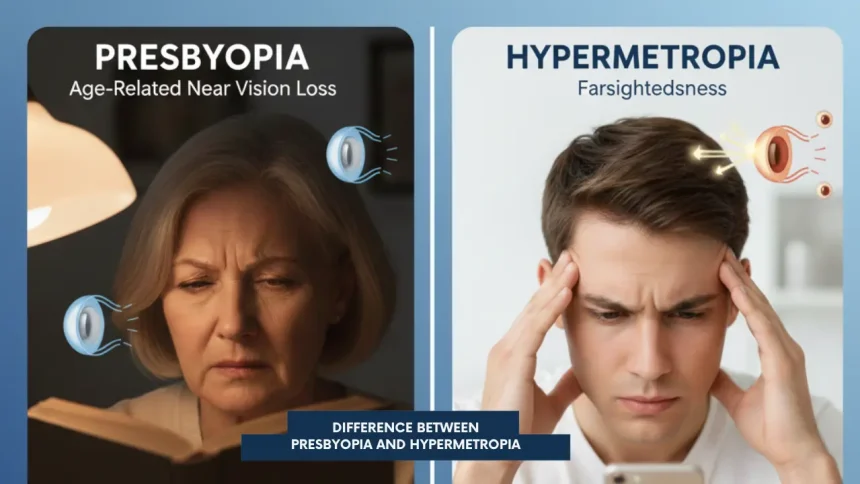
Although both affect near vision, they are not the same. Presbyopia and hypermetropia have different causes, start at different ages, and affect the eyes in different ways. Understanding the difference between presbyopia and hypermetropia can help you choose the right treatment and protect your eye health.
This guide explains presbyopia vs hypermetropia in a clear and simple way. Readers of tryforhealth often ask about these vision problems, especially when reading becomes difficult with age. This article will help you understand what is happening to your eyes and what you can do about it.
What is Presbyopia?
Presbyopia is an age-related vision condition where the eye slowly loses the ability to focus on nearby objects. It usually starts around the age of 40 and affects everyone at some point in life.
Inside the eye, there is a natural lens that changes shape to help you focus. As you get older, this lens becomes stiff and less flexible. Because of this, the eye finds it hard to focus on close objects like books, mobile phones, or sewing work.
Many people first notice presbyopia when they need to hold reading material farther away to see it clearly. This condition is a natural part of ageing and is not considered a disease.
What is Hypermetropia?
Hypermetropia, also called farsightedness, is a refractive error of the eye. In this condition, distant objects are seen more clearly than nearby ones.
Hypermetropia happens when the eyeball is shorter than normal or when the cornea or lens does not bend light properly. Because of this, light focuses behind the retina instead of directly on it. This is a key difference between presbyopia and hypermetropia.
People with hypermetropia may have trouble reading or doing close work. Eye strain, headaches, and tired eyes are common, especially after long periods of near work. Unlike presbyopia, hypermetropia can be present from birth.
Symptoms and Causes of Presbyopia
Understanding the symptoms of presbyopia and causes of presbyopia helps explain the difference between presbyopia and hypermetropia more clearly.
Symptoms of Presbyopia
People with presbyopia often notice blurred vision when looking at close objects. Reading small print becomes difficult, especially in low light. Eye strain and headaches may occur after close work. Many people feel the need for brighter light while reading.
Causes of Presbyopia
Presbyopia is caused by ageing. Over time, the eye’s lens becomes stiff and cannot change shape easily. Changes in lens proteins and reduced flexibility of eye muscles also reduce the eye’s focusing power.
Symptoms and Causes of Hypermetropia
Now let’s look at the symptoms of hypermetropia and the reasons for hypermetropia.
Symptoms of Hypermetropia
People with hypermetropia often experience blurry vision when reading or working on a computer. Eye strain and frequent headaches are common. Squinting to see clearly and tired eyes after close work are also typical symptoms.
Causes of Hypermetropia
Hypermetropia occurs when the eyeball is shorter than normal or the lens and cornea are not curved enough. Genetics play an important role, so it often runs in families. Although it may be present from birth, hypermetropia can become more noticeable with age.
Difference Between Presbyopia and Hypermetropia (Comparison Table)
| Aspect | Presbyopia | Hypermetropia |
| Definition | Age-related loss of near focusing ability | Difficulty seeing close objects clearly |
| Age | Starts around 40 years | Can be present from birth |
| Main Problem | Stiff eye lens | Short eyeball or weak focusing |
| Vision Impact | Affects near vision | Affects near vision more than distance |
| Cause | Natural ageing process | Eye shape and genetics |
| Progression | Worsens with age | May stay stable or change |
| Treatment | Reading or progressive lenses | Convex lenses or surgery |
Presbyopia vs Hypermetropia – Treatment in India
Knowing the difference between presbyopia and hypermetropia helps in choosing the right treatment and maintaining clear vision.
Presbyopia Treatment in India
Presbyopia is commonly treated with reading glasses, bifocal lenses, or progressive lenses. Contact lenses designed for presbyopia are also an option. In some cases, surgical treatments like LASIK or lens implants may be considered to improve near vision.
Hypermetropia Treatment in India
Hypermetropia is usually corrected with glasses or contact lenses that help light focus properly on the retina. Surgical options such as LASIK or PRK may provide long-term correction. Implantable lenses can also be used in selected cases.
Eye specialists associated with tryforhealth often recommend regular eye exams to detect these conditions early and choose the safest treatment.
Summary
Presbyopia and hypermetropia may look similar, but they are different eye conditions. Presbyopia is caused by ageing and affects everyone eventually. Hypermetropia is related to eye shape and can start early in life.
Both conditions can be managed effectively with proper diagnosis and treatment. Understanding presbyopia vs hypermetropia allows you to take better care of your vision and avoid unnecessary strain.
Frequently Asked Questions
Q.1 Are presbyopia and hyperopia the same?
No, presbyopia and hyperopia are not the same. Presbyopia is an age-related condition that affects near focus, while hyperopia is a refractive error related to eye shape.
Q.2 Is presbyopia also known as hypermetropia?
No, presbyopia is not another name for hypermetropia. They are separate conditions with different causes and treatments.
Q.3 What is the other name of presbyopia?
Presbyopia does not have a common alternate name. It is usually referred to simply as age-related near vision loss.
Q.4 What is the second name of hypermetropia?
Hypermetropia is also called farsightedness. Both terms describe difficulty seeing nearby objects clearly.
Q.5 Is it possible to have presbyopia and hypermetropia together?
Yes, a person can have both conditions at the same time. In such cases, vision correction is planned based on detailed eye testing.